Iconography · The Visual Grammar

The tortoise, the posture, the unspoken sermon.

Each visual element associated with Munisuvrata Bhagwan is itself a teaching — a wordless instruction encoded in stone, posture, color, and form.

Lañchana · The Tortoise

The patience of the protected interior.

Every Tīrthaṅkara is identified by a unique lañchana — a sacred emblem inscribed at the base of every consecrated idol. For Munisuvrata Bhagwan, this emblem is the kūrma — the tortoise.

The tortoise is no ornament. It is a complete spiritual instruction:

  • Steadfast It moves slowly, but never abandons direction. So too the seeker — unhurried, unwavering.
  • Patient The discipline of long horizons. Liberation is the work of lifetimes; impatience is its first obstacle.
  • Protected Withdrawing the senses inward, as the tortoise withdraws into its shell — the classical metaphor of pratyāhāra.
  • Endurant Of all creatures, the tortoise carries the longest memory of stillness. So too the soul that remembers itself.

Kūrma · The Tortoise

Iconographic Attributes

A complete grammar of the form.

LañchanaTortoise (Kūrma)
Body HueDark Sapphire / Black
YakṣaVaruṇa
YakṣiṇīNaradattā
Sacred TreeChampaka
PosturePadmāsana / Kāyotsarga
VāhanaTortoise
Tīrtha of MokṣaSammed Shikharji
Idol Postures

Two postures, one stillness.

Every consecrated Jain idol depicts the Tīrthaṅkara in one of two postures — each carrying its own metaphysical weight. Both express the same condition: total inward absorption.

posture i.

Padmāsana The Lotus

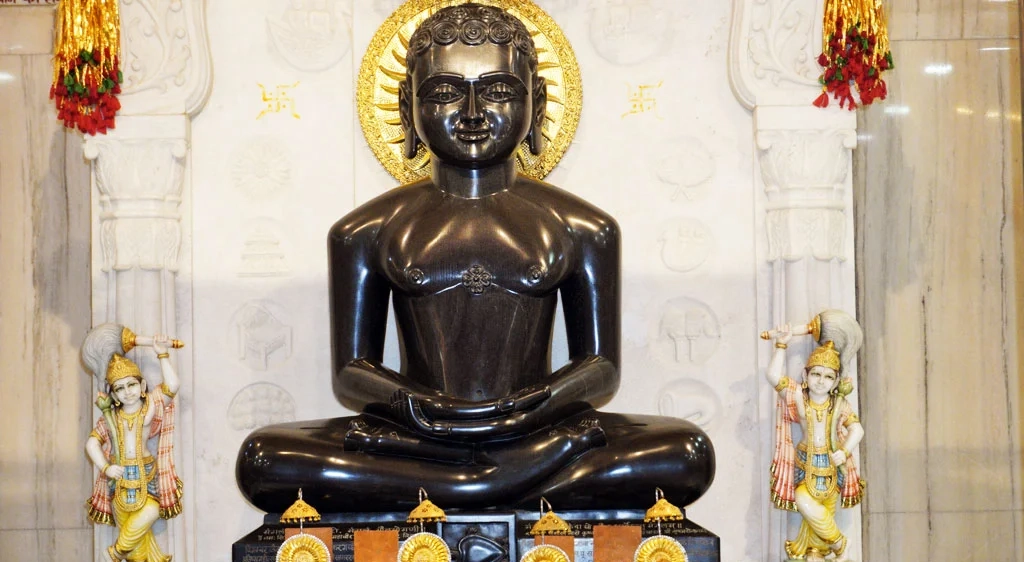
The seated meditation posture. Legs folded, palms resting upward in the lap, gaze drawn inward. The lotus is the form of one who has found absolute peace at the center of all activity.

The pose of the soul that knows it is already home.
posture ii.

Kāyotsarga The Standing

The standing, body-abandoning posture. Arms held loosely at the sides, body utterly still. Kāyotsarga literally means "abandoning the body" — a complete dis-identification with form.

The pose of the soul that no longer mistakes itself for the vessel.

Sacred Aesthetics

The color of devotion.

Jain temple aesthetics rely on a deliberate palette — each hue carrying meaning, each meaning shaping the contemplative atmosphere.

Body Hue Dark Sapphire
Sanctity Matte Gold
Earthen Sandstone
Purity Ivory
Auspicious Sindoor
The Sacred Cluster

Symbols of the Jain world.

The Tīrthaṅkara never appears alone in iconography. He is held within a constellation of symbols, each contributing to a complete metaphysical statement.

·

Aṣṭamaṅgala Eight Auspicious

Eight sacred emblems — including the swastika, the śrīvatsa, the throne, the mirror, and the full vase — placed before every consecrated idol.

·

Triratna Three Jewels

The trinity of right perception, knowledge, and conduct — depicted often as three flames or three luminous orbs.

·

Samavasaraṇa Divine Assembly

The circular tiered hall in which a Tīrthaṅkara delivers his first sermon — humans, animals, and devas listening in shared silence.

Shri Munisuvratnath Mandir, DLF Phase 2, Gurugram — interior
Temple Representations

A geography written in marble.

Munisuvrata Bhagwan is enshrined in temples across India — from the urban sanctuaries of Gurugram and Pune to the ancient pilgrimage sites of Saran Tirth and Sammed Shikharji.

Each temple shares a recognizable visual vocabulary: the central murti seated or standing in serene composure, the tortoise emblem at the pedestal, the sacred Champaka motif in the carved screens, and the nine-fold mandala ceiling that draws the gaze inward and upward.

View Gallery