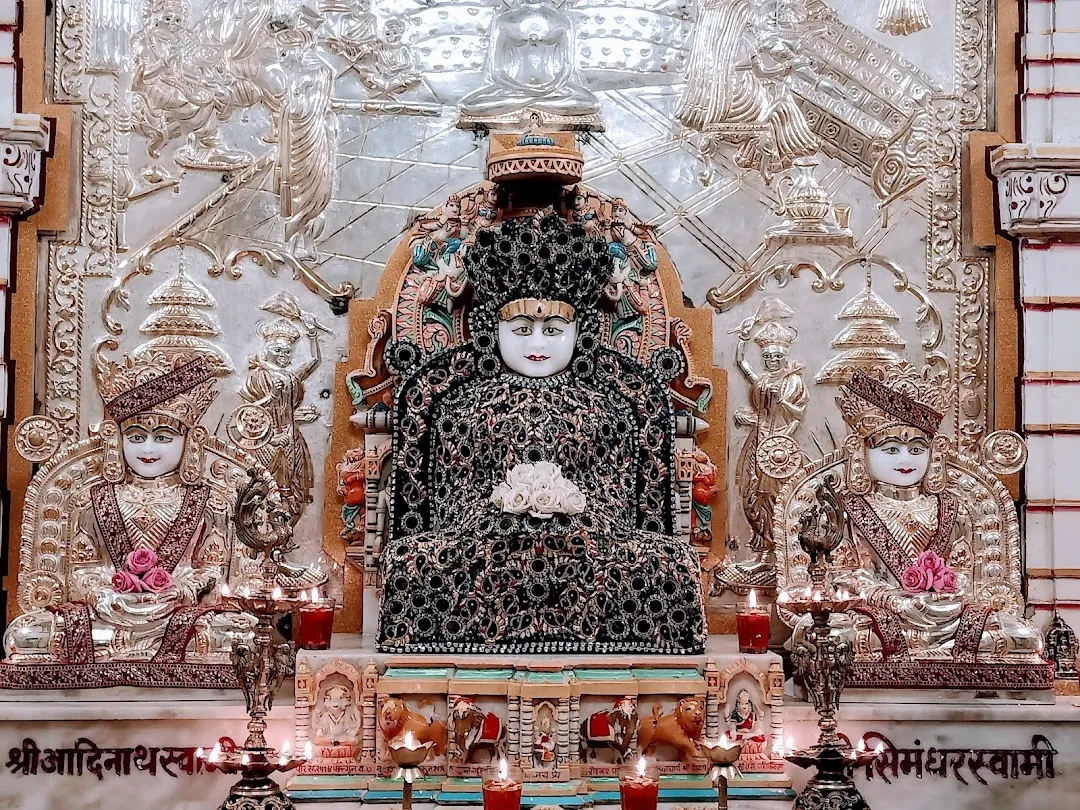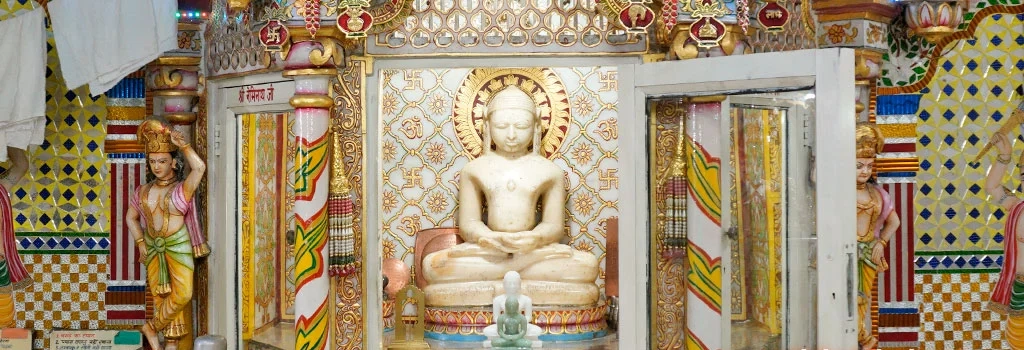
A Living Tradition

Symbolism
& Sacred Heritage

Every emblem, every tree, every attendant deity around a Tirthankara holds a luminous meaning. Here is the symbolic vocabulary that surrounds Shitalanatha Bhagwan — an iconography of profound stillness.

Sacred Emblems

Two Traditions, One Tirthankara

In the Digambara tradition, the emblem of Shitalanatha Bhagwan is the auspicious Svastika; in the Svetambara tradition, the Srivatsa. Both convey the same eternal truth in different visual languages.

Digambara Tradition

Svastika

The Svastika represents the four states of existence in the cycle of saṃsāra — heavenly, human, animal and infernal — and the soul’s aspiration to transcend them all. Its still centre is the soul itself, around which the four petals turn.

  • Four ArmsThe four destinies of the soul in transmigration.
  • CentreThe pure self, untouched by the wheel of becoming.
  • Three DotsThe triple jewel — right faith, knowledge and conduct.
Svetambara Tradition

Srivatsa

The Srivatsa is the auspicious mark on the chest of a Tirthankara — an eternal emblem signifying purity of heart, infinite knowledge, and the radiance that emanates from a soul wholly free of karma.

  • PositionOn the chest, near the heart-cakra of the Tirthankara.
  • MeaningThe emblem of Śrī — auspiciousness eternally abiding.
  • SignificanceA sign of one in whom the soul is fully revealed.
The Sacred Court

Tree, Yaksha & Yakshi

Surrounding every Tirthankara are sacred attendants — the tree beneath which renunciation flowered, and the celestial yaksha and yakshi who guard the legacy of his teaching.

Sacred Pilurikha tree imagery
Sacred Tree

Pilurikha (Pīlū) Tree

It was beneath the Pilurikha tree that Shitalanatha Bhagwan undertook his Great Renunciation. The tree thus stands as a silent companion to his enlightenment — an arboreal witness to the moment a prince became a path.

Brahma Yaksha imagery
Yaksha

Brahma Yaksha

The presiding yaksha of Shitalanatha Bhagwan is Brahma — a celestial guardian invoked for the fourfold protection of dharma, devotees, scriptures and sacred precincts. He embodies the masculine aspect of divine watchfulness.

Yakshi imagery
Yakshi

Manavi · Ashoka

In the Digambara tradition, his Yakshi is Manavi; in the Svetambara tradition, Ashoka. Both represent the maternal, sustaining aspect of grace — protection, abundance and benediction for the sincere seeker.

In the Lineage of Twenty-Four

His Place Among the Tirthankaras

The present cosmic age is illumined by twenty-four Tirthankaras — ford-makers across the river of saṃsāra. Shitalanatha Bhagwan is the tenth, occupying a sacred middle position in this celestial procession.

He is preceded by Pushpadanta Bhagwan (9th) and followed by Shreyansanatha Bhagwan (11th). Each Tirthankara amplifies a particular dimension of dharma; Shitalanatha’s gift to the lineage is the dimension of śīlatā — sacred coolness, equipoise and inner peace.

  • Order10th of 24 Tirthankaras of the present age
  • Preceded byShri Pushpadanta Bhagwan (9th)
  • Followed byShri Shreyansanatha Bhagwan (11th)
  • Distinct GiftThe teaching of inner coolness — śīlatā
Shri Shitalnath Jain Shwetambar Mandir – temple architecture
Temples & Reverence

The Living Heritage

Across India and beyond, Jain communities honour Shitalanatha Bhagwan with magnificent temples, daily rituals and recurring festivals. Every doorway is a portal to his serene presence.

Bhaddilpur

Sacred Birthplace

The very dust of this ancient city is venerated as tirtha — the sanctified land of the Tenth Tirthankara’s descent.

Champapuri

Pilgrimage Centre

An ancient pilgrimage destination linked to several Tirthankaras, where his legacy continues to be honoured.

Modern Temples

From Kolkata to Gujarat

From the marble courts of Pithwara Mandir to the historic Sheetalnath temple of Kolkata, his presence radiates across the subcontinent.

24Tirthankaras of the Age
10thPosition in Lineage
5Sacred Kalyāṇaka
Soul’s Eternal Light
The emblem on the chest of a Tirthankara is not an ornament — it is a window into the formless, marked upon the form for our remembering.
— On the Symbolism of Tirthankaras